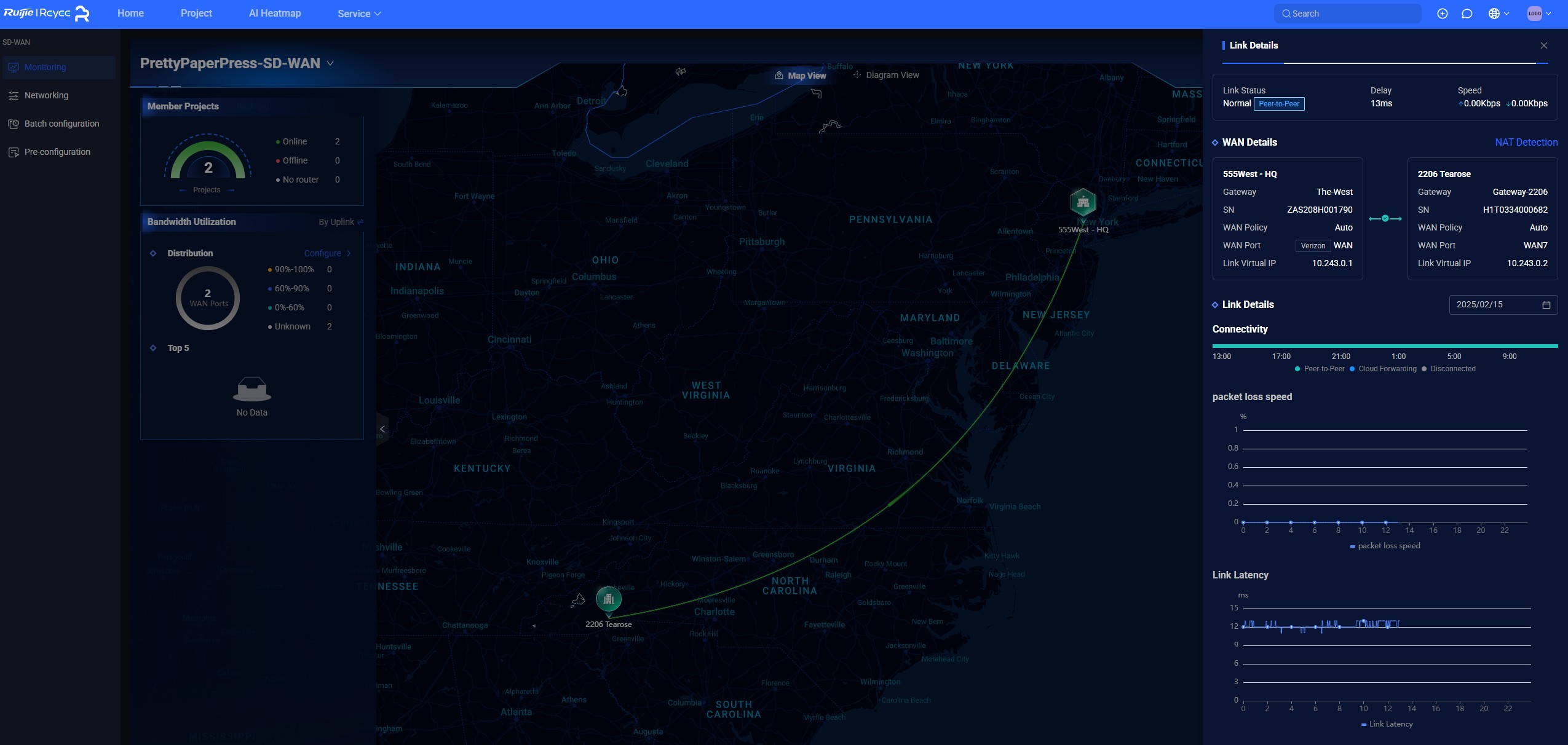
I am still beta testing the SD-WAN from Reyee. My son is able to connect to my NAS, without me exposing the NAS to the internet. Also, using a GLiNet travel router configure using wireguard. The goal is to use SD-WAN between my sons and my network and retire the travel routers. Reyee has not post the the cost to use the SD-WAN.
Is their SD-WAN solution based on Wireguard? Does the router have to have a public IP for this to work? Are they also going to build zero trust type networking into this?
The information from Reyee.
There are two methods for communication between two branches. One is direct device-to-device communication, referred to as the P2P direct connection method. The other is message relay via a supernode, referred to as the forwarding mode. When neither branch has a public IP address (e.g., most residential broadband services lack public IPs), NAT traversal will be attempted. If NAT traversal succeeds, P2P communication can be established between the branches. Otherwise, communication must rely on supernode forwarding.
When does NAT traversal fail? Currently, there are four types of NAT: full cone, restricted cone, port-restricted cone, and symmetric NAT. Due to the characteristics of NAT types, there are three combination scenarios where NAT traversal is theoretically impossible: []Port-restricted cone + Symmetric NAT []Symmetric NAT + Symmetric NAT [*]IP-restricted cone + Symmetric NAT How to determine the type of NAT? The NAT type is related to the outbound ISP, region, and link mode.
1 Like
Nice! Can’t wait to see your full impression of the setup!
Going to purchase another Reyee router for my 2nd son to link all 3 networks together.
1 Like